
Release 4 – May 3, 2026
New Features and Enhancements
Cross-Portal Enhancements
Disclaimer: on rare occasions, a new feature or enhancement may be moved to a future release or otherwise subject to change.
New Combined Race and Ethnicity Question Block
This enhancement must be approved by the CAS association or UniCAS client for use in the next cycle. If activated, this enhancement will be available for all participating programs in the next cycle. CAS association and UniCAS clients: contact a member of your account team for more information or to enable this feature.
In March 2024, the US Office of Management and Budget (OMB) published a set of revisions to Statistical Policy Directive No. 15: Standards for Maintaining, Collecting, and Presenting Federal Data on Race and Ethnicity (SPD 15). These revisions include:
- Collecting data using a single combined race and ethnicity question, allowing multiple responses.
- Adding Middle Eastern or North African (MENA) as a minimum reporting category, separate and distinct from the White category.
- Allowing the collection of more detail beyond the minimum race and ethnicity reporting categories.
These changes enhance the ability to compare information and data across federal agencies and aim to understand how well federal programs serve a diverse America. Liaison's suite of products support these new race and ethnicity revisions and allow CASs to use them when collecting race and ethnicity data from applicants.
CAS Applicant Portal
CASs can choose from two versions of the new combined race and ethnicity question: one that allows only major-category selections and another that includes subcategory selections (with the option to write in responses). Note that subcategory options cannot be customized.
Only major category selections
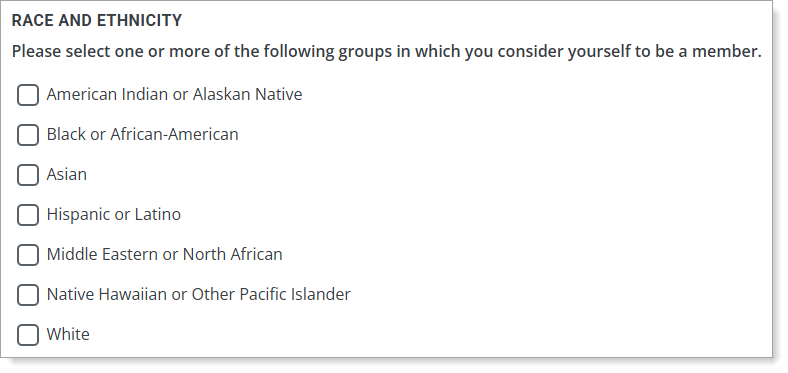
Including subcategory selections and write-in responses

CAS API
The CAS API has been enhanced to support the new combined race and ethnicity blocks. See the Simplifying Federal Change: How Liaison Supports Compliance and Adaptation page for detailed instructions, including details on the new end points and a data dictionary file for the new fields.
Liaison Analytics
The Demographic dashboards and filters will automatically be updated to accept the new combined race and ethnicity major categories (subcategories are not included in any Dashboards).
Liaison Outcomes
If your CAS uses the new combined race and ethnicity block, and you include race and ethnicity data in any reports, exports, or segments, you will need to update them to point to the new field and values. See the Simplifying Federal Change: How Liaison Supports Compliance and Adaptation page for detailed instructions, including a data dictionary file for the new fields.
WebAdMIT
If your CAS uses one of the new combined race and ethnicity questions, note that the existing Applicant Ethnicities field grouping will be removed from and the new Applicant Race and Ethnicity field grouping will be added to the List Manager, Export Manager, and Applicant Header. You may need to update existing templates and data imports for these new fields. See the Simplifying Federal Change: How Liaison Supports Compliance and Adaptation page for detailed instructions, including a data dictionary file for the new fields.
Note that the new combined race and ethnicity questions are not available in Scoring (the separate legacy race and ethnicity questions are).
For the Report Manager, all race and ethnicity-related reports will automatically be updated to accept the new combined race and ethnicity major categories (subcategories are not included in any reports). Additionally, note the change in behavior for the Hispanic or Latino category:
- When using the separate legacy race and ethnicity questions, Hispanic or Latino is considered an ethnicity, and all other categories are races. If an applicant selects both Hispanic or Latino and another major race category, they are only reported in the Hispanic or Latino category in reports. This is known as the IPEDS "trumping rules."
- When using the new combined race and ethnicity question, Hispanic or Latino is considered a major race category. If an applicant selects both Hispanic or Latino and another major race category, they will either be reported in a Multiple category or, for reports that ignore two or more race categories, in each major category they select.
Finally, note that the Hispanic (Yes / No / Blank) field, which distinguishes between applicants who responded "no" versus those who did not select an answer, is only available for the legacy Ethnicity question and is not available for CASs that use the new combined Race and Ethnicity question.
Preferred First Name Available as Email Token
This enhancement must be approved by the CAS association or UniCAS client for use in the next cycle. If activated, this enhancement will be available for all participating programs in the next cycle. CAS association and UniCAS clients: contact a member of your account team for more information or to enable this feature.
You can now use the applicant's preferred first name instead of their legal first name when sending emails through WebAdMIT and Liaison Outcomes (available by request). This allows you to communicate with applicants who may go by a different first name (for example, their legal name is a deadname). Note the following behaviors:
- The CAS Applicant Portal must use the standard My Name question.
- If an applicant does not enter anything in the My Name question, then their legal first name will automatically populate into the preferred first name email token.
Annual Spring Lookup Updates
This enhancement is automatically available for use by all CASs and participating programs. No action is required on the part of any association, school, or program. Contact a member of your account team for more information.
Many fields in the CAS Applicant Portal contain predefined answer values that applicants can select; for example, the Country and County fields both have predefined answer values. These values are housed in shared "lookup tables." Periodically, we update these tables to include additional response options.
The Master High School List has been updated, including the high school CEEB codes from the College Board. Review the Shared Lookup Table Updates page for a full list of updates.
These lookup table updates impact the following portals, some of which you may use. If you created a "crosswalk" from our portals to your local data in your SIS/CRM, you may need to update this crosswalk for the newly-added options. For guidance on the optimal implementation of the new values, review the Shared Lookup Table Updates page.
CAS API Enhancements
The following enhancements are automatically available for the CAS API, and no action is required on the part of any school or program. If you have any questions about these features, contact support.
Disclaimer: on rare occasions, a new feature or enhancement may be moved to a future release or otherwise subject to change.
Support for Manual Designations in CAS API Subscriptions
The CAS API subscription APIs have been updated to support manual designations. The application.updated and other applicable events will be triggered when a designation is manually added to an application in WebAdMIT, during the reapplicant process, or by Liaison.
New CAS API Completion Status Data Documentation
Tracking your applicants' progress through the CAS application is available in the CAS API data. Please review the Tracking Application Progress with Completion Status documentation to learn about how to review this information.
CAS Applicant Portal Enhancements
Disclaimer: on rare occasions, a new feature or enhancement may be moved to a future release or otherwise subject to change.
Submission Workflow for CASs with No Application Fees
This enhancement must be approved by the CAS association or UniCAS client for use in the next cycle. If activated, this enhancement will be available for all participating programs in the next cycle. CAS association and UniCAS clients: contact a member of your account team for more information or to enable this feature.
For CASs that do not collect application fees from applicants, a new submission workflow is available that removes any mention of payment. Applicants only need to confirm the programs they want to submit to, then click Submit. This streamlines and simplifies the submission process.

The Payment History section under the Applicant Menu (person icon) has also been removed to avoid any confusion around payments.
Liaison Analytics Enhancements
The following enhancements are now available in Liaison Analytics. If you have any questions about these features, contact a member of your account team or support.
Disclaimer: on rare occasions, a new feature or enhancement may be moved to a future release or otherwise subject to change.
Coming Soon: Deactivation for Inactive Accounts
Starting in early November, users who haven't logged into Liaison Analytics in the past 18 months will have their accounts deactivated. This enhances the security of Analytics and ensures only current and active users can access data.
Liaison Outcomes Enhancements
The following enhancements are now available in Liaison Outcomes. If you have any questions about these features, contact a member of your account team or support.
Disclaimer: on rare occasions, a new feature or enhancement may be moved to a future release or otherwise subject to change.
Authorize.Net Integration Updated with Transaction Description
This enhancement will automatically be available for use starting the week of May 11 for use by all CASs and participating programs. No action is required on the part of any association, school, or program. Contact a member of your account team for more information.
If you use Authorize.net as a payment provider for your applicants, the transaction description that appears on their bank/financial statements will now appear as Application/Deposit Fee. This updated description is not retroactive, so previous Authorize.net payments will retain their existing descriptions.
Updated Settings Menu Organization
This enhancement is automatically available for use by all CASs and participating programs. No action is required on the part of any association, school, or program. Contact a member of your account team for more information.
We've reorganized the Settings Menu to increase clarity and make it easier to navigate. Settings are now grouped more intentionally, with organization-wide (global) items at the top and application- or cycle-related items grouped lower in the menu.
As part of this update:
- Some sections (e.g., Application Setup, Application Review, and Import/Export) have been moved to new positions in the menu.
- Data Sources have been separated into Contact Data Sources and Application Data Sources for easier access.
These changes are part of ongoing improvements to how settings are structured, but there is no change to existing functionality. Only the layout and organization of the menu have been updated.
ResidencyCAS Program Portal Enhancements
Updated Settings Menu Organization
We've reorganized the Settings Menu to increase clarity and make it easier to navigate. Settings are now grouped more intentionally, with organization-wide (global) items at the top and application- or cycle-related items grouped lower in the menu.
These changes are part of ongoing improvements to how settings are structured, but there is no change to existing functionality. Only the layout and organization of the menu have been updated.
Clerkship Grades Available in the Applicant PDF
Clerkship grades are now included in the application PDF under the Medical Schools Attended section. This change makes it easier to analyze clerkship grades when exporting data from ResidencyCAS. Additionally, you can select these grades when creating a custom export.

Transfer Planner Enhancements
The following enhancements are now available in CSU Transfer Planner Student and Campus (i.e., University and Community College) Portals. If you have any questions about these features, contact a member of your account team or support.
CSU Transfer Planner Campus (i.e., University and Community College) Portals are built upon the Liaison Outcomes product, and so where you see "Outcomes" listed below, it applies to CSU Transfer Planner as well.
Disclaimer: on rare occasions, a new feature or enhancement may be moved to a future release or otherwise subject to change.
University Portal: Program Review Statuses in Configuration Portal
University Portal users can use the configuration review statuses to alert the Chancellor's Office that their programs are ready for review. The Chancellor's Office can then approve the program so it can go live in the Student Portal, or return it to the campus as a draft for additional edits.
Additionally, University Portal users can return to the Program Confirmation page to make edits to their programs using the new edit pencil icon for the Action drop-downs.
New Documentation for Outcomes
Please review the list of new and updated documentation, all accessible in the Liaison Outcomes Help Center.
|
Document |
Details |
|---|---|
| Identifying Degree Types |
Our Advanced Configuration Library provides guidance to help you build custom configurations in Outcomes. In our latest article, Identifying Degree Types, you'll learn to build a field that indicates whether your degree requirement has been met by each applicant. |
| Designing Workflows in Outcomes |
This updated article guides you in using Workflow Automation to make actions occur in Outcomes once certain conditions are met. |
| Scheduling Automated Actions in Outcomes |
This updated article guides you in using Automation Rules to schedule Outcomes actions to happen at specific times. |
New Documentation for WebAdMIT
Please review the list of new and updated documentation, all accessible in the WebAdMIT Help Center.
|
Document |
Details |
|---|---|
| Date Field Reference Guide |
In WebAdMIT, applicant files contain various date fields. Some of these dates are affected by applicant activities, while others are affected by the CAS processing documents or other data points. You can review the most common applicant date fields in this guide. Note that you can use many of these dates when identifying new and updated applicants. |
| Simplifying Federal Change: How Liaison Supports Compliance and Adaptation |
Liaison is committed to supporting you as you navigate evolving legal and regulatory landscapes. This article provides guidance on how Liaison's products can support your institution's approach to recent legislative changes. |
Ongoing Maintenance
Please review the list of scheduled downtime/maintenance and product updates.
|
Event |
Date |
Details |
|---|---|---|
|
Sandbox Environment Refresh |
April 30, 2026 |
The WebAdMIT Sandbox environment (uat.webadmit.org) was refreshed with current (cleansed) production data and program configurations. Any test exports, custom fields, etc., in the current sandbox were overwritten. The next sandbox environment refresh is scheduled for May 28, 2026. |
Coming Soon!
Please review the list of upcoming events, including product updates and regional training opportunities.
|
Event |
Date |
Details |
|---|---|---|
|
CAS 3+ Upgrade |
2026 |
Liaison is excited to announce that in the 2026-2027 application cycle, all of our Centralized Application Services (CAS) will be upgraded to a new, mobile-first, and modern applicant portal that we call CAS 3+. Visit the CAS 3+ Upgrade page to learn more about its key benefits and a preview of the upgraded application. |
|
experience: LIAISON | Baltimore |
June 8–10, 2026 |
Set sail with us to explore new strategies, uncover trends shaping the future, and dive into real stories of transformation from peers using Liaison's solutions at experience: LIAISON, June 8–10, 2026 in Baltimore, MD. Register now! |
|
Shared Lookup Table Updates for Fall 2026 |
August 2026 |
Many fields in the CAS Applicant Portal contain predefined answer values that applicants can select; for example, the Country and County fields both have predefined answer values. These values are housed in shared "lookup tables" which are viewable in your CAS's/UniCAS's data dictionary file. Lookup table change requests can be sent to a member of your account team, who will compile and review these requests. New lookup table values will appear in the CAS Applicant Portal in August 2026 (subject to change). Visit the Shared Lookup Table Updates page for more information. |